Best AI Image Generation APIs in 2026
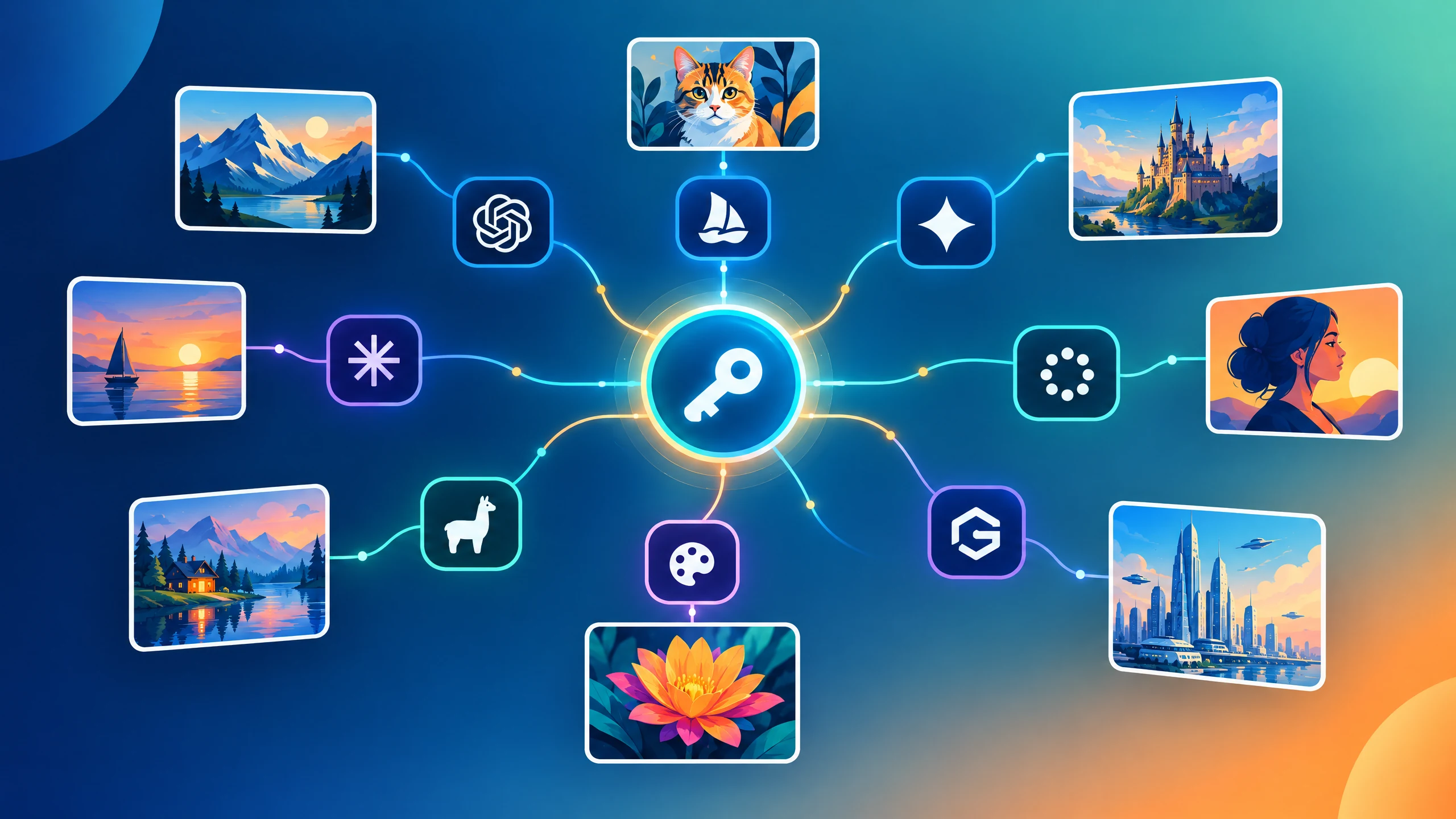
There's no single best AI image generation API — it depends on whether you optimize for speed, model breadth, price, or integration. Here's a shortlist of the strongest options and what each is actually best at.
If you've been generating images in a web tool and want to go further — batch generation, commercial volume, or wiring image generation into your own product — you'll need an API. These are the ones worth looking at in 2026.
The APIs worth considering
fal.ai — fastest inference
fal.ai is engineered for speed, with sub-second generation on optimized pipelines and strong enterprise adoption. If raw latency at scale is your hard constraint, it's built for it, at a premium.
Best for: latency-critical products with the budget to match.
Replicate — biggest model hub and discovery
Replicate is the best-known place to find and run open models, with excellent docs and a huge community catalog.
Best for: experimentation and breadth of open models; less focused on lowest price.
HiAPI — all-in-one with competitive pricing
HiAPI gives you one API key for image, video, audio, and LLM models — GPT Image 2.5, Nano Banana 2, Seedream 5, FLUX 2, Qwen Image and more — with an OpenAI-compatible endpoint, a native MCP server, pay-as-you-go pricing and failed-tasks-free billing. Pricing is aggressive on some models (GPT Image 2.5 runs as low as $0.025 per image on a current promo), and it's one of the few that also takes Alipay/WeChat alongside cards. It's newer than fal or Replicate, so the ecosystem is less mature, but the all-in-one coverage and price are the draw.
Best for: teams that want many models under one key, OpenAI-style integration, and good value.
KIE.ai — cheap across a broad catalog
KIE.ai leans hard on price across 100+ models, with failed-tasks-free billing. A solid pick if the lowest headline price on mainstream models matters most.
Best for: price-sensitive teams on mainstream models.
Runware — lowest per-image price
Runware runs its own hardware and pushes per-image cost extremely low, especially on open models.
Best for: very high-volume image generation where unit cost dominates.
Quick comparison
| API | Best at | Modalities |
|---|---|---|
| fal.ai | Fastest inference | Image / Video |
| Replicate | Model discovery & open models | Broad |
| HiAPI | All-in-one + competitive price | Image / Video / Audio / LLM |
| KIE.ai | Cheap, broad catalog | Image / Video / Music / LLM |
| Runware | Lowest per-image price | Image-focused |
How to choose
- Latency is everything? → fal.ai.
- Exploring open models? → Replicate.
- Many models under one key + good value? → HiAPI.
- Lowest headline price on mainstream models? → KIE.ai.
- Rock-bottom per-image cost at scale? → Runware.
Frequently Asked Questions
What is the best AI image generation API in 2026? It depends on your priority: fal.ai for speed, Replicate for open-model breadth, KIE.ai or Runware for price, HiAPI for all-in-one coverage and value. Match it to what your product actually needs.
Which image API is easiest to integrate? Any with an OpenAI-compatible endpoint is lowest-friction if you already use OpenAI-style code — HiAPI offers one, plus an MCP server for agent setups.
Which is cheapest? On raw per-image cost, Runware and KIE.ai are usually the most aggressive. HiAPI is competitive on promos. Compare your specific models and volume on each platform's pricing page before committing.
Can one API cover GPT Image, Nano Banana, Seedream and FLUX? Aggregators like HiAPI expose all of these through a single key, so you can A/B models without a separate integration for each.
Bottom line
Pick by your binding constraint. Speed → fal.ai. Open-model breadth → Replicate. Lowest price → Runware or KIE.ai. Many models under one key with competitive pricing → HiAPI. There's no universal winner; the right one is the one that fits your workload.
Subscribe to ToolCenter Newsletter
Get the latest AI tool rankings, content templates, and growth experiments delivered every Friday.
Next in Deep Dives
Continue your journey

Best AI Presentation Tools in 2026: 10 Slide Makers Compared
AI presentation tools in 2026 range from full-deck generators that build slides from a single prompt (Gamma, Tome) to AI-assisted design platforms that enhance your existing workflow (Canva AI, Beautiful.ai).

Best AI Photo Enhancer Tools in 2026: 8 Options Compared
AI photo enhancement in 2026 ranges from free browser-based tools to professional desktop software costing hundreds of dollars per year.

Cursor vs GitHub Copilot vs Windsurf in 2026: The Definitive Comparison
The AI code editor market in 2026 has three serious contenders: Cursor (the innovation leader), GitHub Copilot (the enterprise standard), and Windsurf (the value challenger).